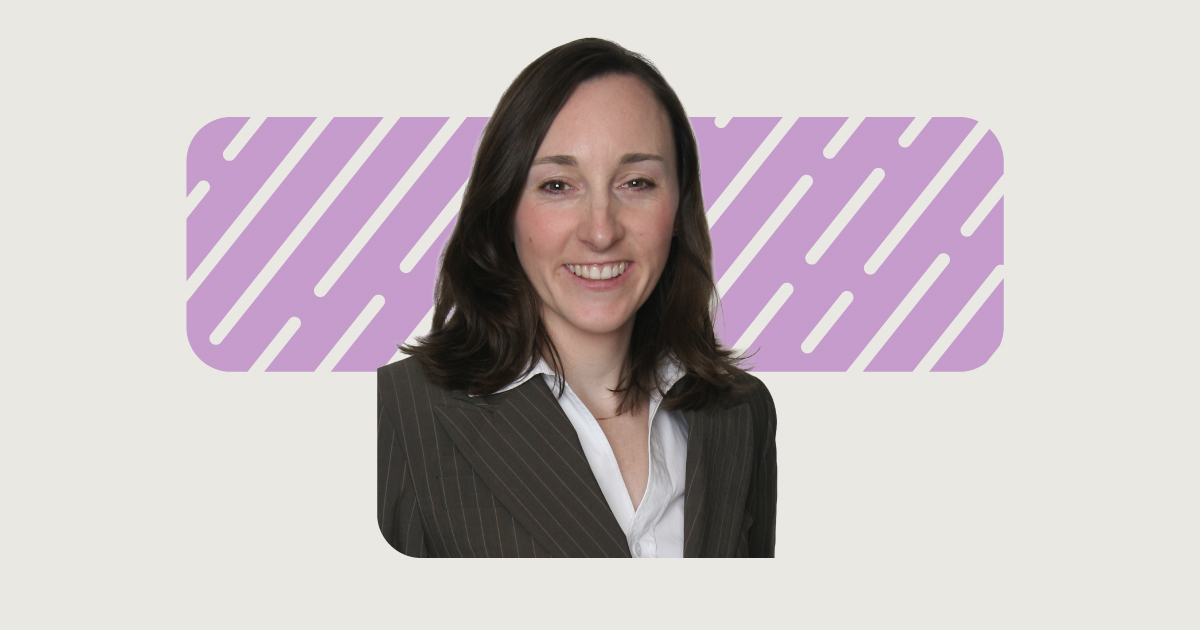
There are many people powering the work of the Canadian Centre to End Human Trafficking, including the members of our board. In this series, we’re introducing you to the people who help guide our work and sharing, in their own words, the experiences and perspectives they bring to the Centre.
Jennifer Fiddian-Green joined the Centre’s board of directors in 2018 and was appointed board chair in 2022. Her leadership at the Centre builds on a career in forensic accounting and financial investigations. At Grant Thorton LLP, she leads the forensic advisory practice and has extensive experience leading teams and investigations into financial crime. That work has given her a unique perspective on how financial systems can help identify and disrupt human trafficking.
What first inspired you to get involved with the Canadian Centre to End Human Trafficking?
I was first drawn to the Centre when I learned about this crime through my professional work as an investigative forensic accountant. Much of my work involves cases that involve criminality, proceeds of crime, the tracing of illicit funds and other complex issues. And when I started to learn about human trafficking — particularly that it was happening here in Canada and often involved Canadian youth — it affected me differently than the other types of crime and fraud I encounter in my work.
This felt more personal: the manipulation, abuse and targeting of vulnerable and innocent persons….
At the same time, I learned that there is so much we — the greater, collective we — can do to spot and disrupt these crimes. I just started getting busy trying to learn about human trafficking and connect more dots.
Back in 2017, I had the opportunity to interview two detectives from sex trafficking investigative teams, both of whom worked in Ontario. I worked with them to understand all they knew about the financial side of these cases and how the money moved. Make no mistake: this is about the money. We were able to publish some of the earliest research on financial flows linked to human trafficking.
The work they were doing, the care they showed for the young women involved, and the pain and burden they carried really moved me.
What is one thing you wish more people understood about human trafficking?
We need more people to understand that this doesn’t have to happen. The challenges are huge, but they’re not insurmountable. We can build communities where people are protected, supported and celebrated, not harmed. I personally believe that once you know the details of these crimes — whether it’s sex trafficking or labour trafficking — you can’t unknow what you’ve learned. And if we build a world where family members — mothers, fathers, brothers and sisters — look out for one another and hold one another to account, we can get closer to ending this.
These crimes are not okay. Ever.
Right now, too many of us don’t know about human trafficking or are able to look the other way. We need to change that. And while we need the support of our law enforcement, I don’t believe that it’s up to law enforcement to end this for us. We need leaders across society, including civic, community and business leaders, to take an active role in ending human trafficking.
What has surprised you most since joining the board?
I’ve been most surprised by how much the Centre has grown. These are complex, multilayered issues involving so many different stakeholders. We need to keep moving ahead to disrupt and end human trafficking. At the same time, it has to be done with care, empathy and support.
There are many, many challenges ahead. The Centre staff and board know this. However, we’re better equipped to navigate that complexity and provide the care and support our communities need to move forward.
Can you share a moment during your time with the Centre that has stayed with you?
When I was first asked to take on the role of board chair, I made time to review the research, reports and other background materials that led to the creation of the Centre. I read about cases involving the trafficking and abuse of young women and girls, and how it had been allowed to happen within societal structures that were built, and sometimes lauded, in my lifetime.
I was just appalled.
While this has stayed with me, I also take hope in knowing that if these systems can be built, they can also be changed and rebuilt. Together, we can build a society and communities that protect people and shine a light where harm might otherwise go unseen.
Why do you believe this work matters now more than ever?
While we need to approach change with care and empathy, we also need to act with urgency. Every day that human trafficking is allowed to continue is one day too many.
We’re grateful to Jennifer for sharing her perspective and for her continued contribution to the Centre’s work.
Over the coming months, we’ll continue introducing you to the people who help guide our work. Follow along as we meet more members of our board.
You also can find out more about the people guiding our work by consulting our leadership page.